A technical overview of the Mylly.AI platform's architecture, features and extensibility. Designed for CTOs, architects and engineering leaders.
High-level architecture summary
Mylly.AI is a modular AI platform for building organisation-specific AI solutions. The platform provides built-in core capabilities (chat, file processing, image generation, web search) and an extensible Skills framework that connects AI to the company’s own systems and data.
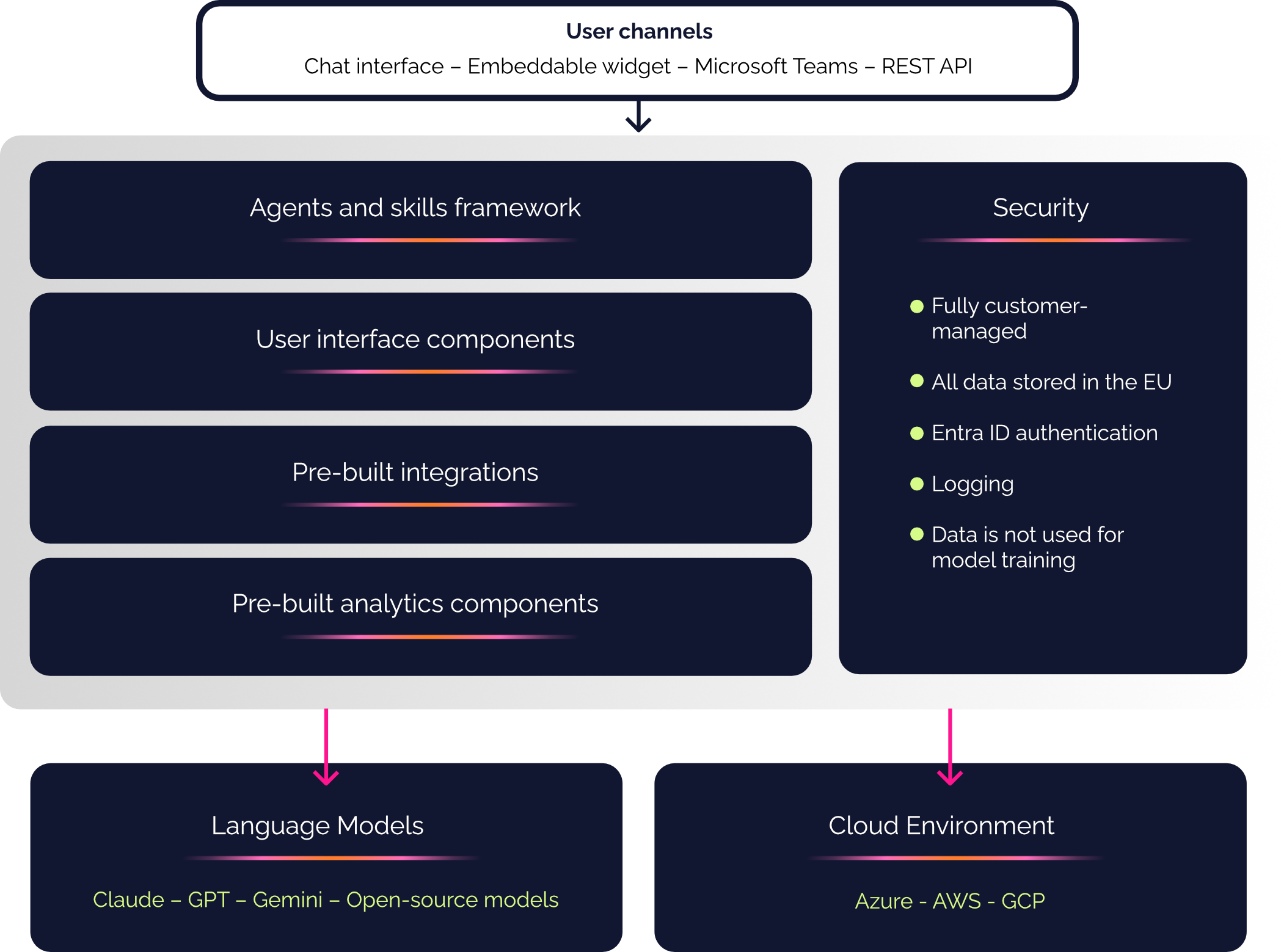
Three core principles guide the architecture:
- Model independence: Mylly.AI supports several language models and providers at the same time. The best model is selected for each task, and switching to a better model requires no changes to the application.
- Extensibility: The Skills framework connects AI models to the company’s own systems, databases and business logic. The platform’s extensible architecture makes it easy to build new integrations.
- Security: Mylly.AI is installed in the customer’s own cloud environment (Azure, AWS or GCP). All data stays in the EU and under the customer’s control. User management integrates with Microsoft Entra ID.
Conversation features
Mylly.AI provides a powerful Chat API on top of which conversational AI applications are built. Applications range from a secure Private ChatGPT solution to sophisticated process and customer assistants.
Conversations can handle a wide range of content:
- Text: natural language conversations, summaries and analyses
- Image files (PNG, JPEG): image analysis and visual understanding
- Audio files: transcription and analysis
- Documents (PDF, Word, Excel): reading files and using them as part of a conversation
The platform includes a flexible prompt template system for creating and managing dynamic, complex AI instructions. Responses are streamed to the user in real time.
Image generation and editing
Mylly.AI supports image generation and editing using text prompts. The platform is integrated with several image generation models. A ready-made image generation interface is available to the whole organisation.
File processing and analysis
The platform includes ready-made tools for automatically reading various file formats (PDF, Word, Excel and so on) and using them in AI processes. This enables organisations to analyse large document collections and extract key information efficiently.
Semantic search and embeddings
Mylly.AI offers the ability to create and use semantic embeddings. This makes it possible to search based on meaning rather than keywords. The feature is critical, for example, in product information search, querying document collections and making efficient use of databases.
Assistants and agents
Mylly.AI supports creating autonomous assistants (agents). Assistants can carry out multi-step tasks using tools such as web and file search. The agentic architecture enables complex workflows in which the AI decides for itself which tools and data sources to use to complete a task.
Mylly.AI also includes a ready-made interface for using web search.
Skills architecture
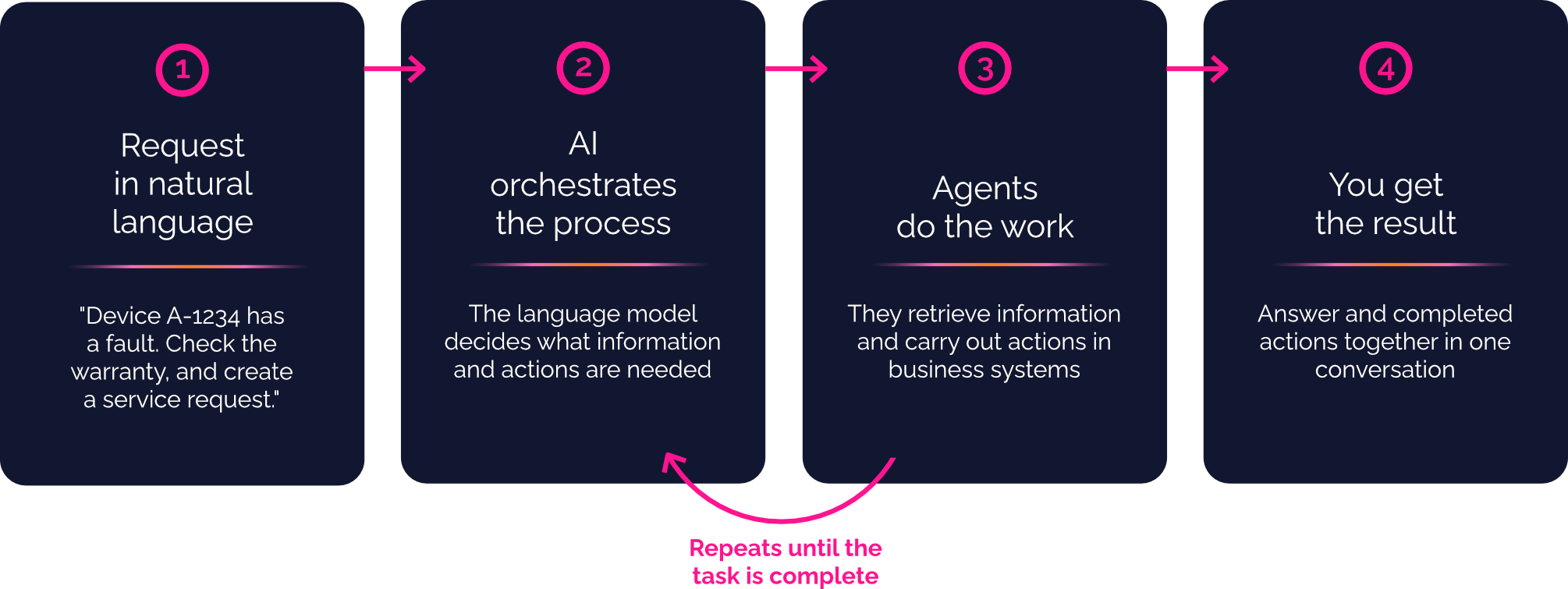
The Skills architecture is Mylly.AI’s most important differentiator. Skills modules are reusable functions that are registered for the language model to use, allowing the AI to call external systems, databases and business logic during a conversation. Mylly’s Skills architecture is model-independent, so the same skill implementation works with, for example, Anthropic’s, OpenAI’s and Google’s models.
Customer implementations based on the Skills architecture
In practice this means:
- The AI can retrieve information from a product database, create a customer service ticket or run calculations as part of a natural language conversation
- The language model determines when and which Skills modules to invoke
- Several Skills modules can be called in sequence within a single conversation turn to complete a multi-step task
- Skills modules can return data both to the language model (for further reasoning) and to the user interface (for visual display, for example product cards)
Examples of Skills modules already built:
| Skill | Description | Example |
|---|---|---|
| Product search | Queries the product catalogue with AI-selected filters | Aurinkomatkat travel assistant |
| Product display | Renders product recommendations as visual cards with purchase links | AI product recommendation |
| Process automation | Writes to and reads from ERP systems | Handling of Anora's order confirmations |
| Document search | Retrieves and interprets service descriptions and contracts | ISS service-description assistant |
| Calculations | Runs calculations according to business logic | Event product-quantity calculator |
Built-in UI components
Mylly.AI includes ready-made UI components that speed up the development of AI applications:
- Conversation interface: a ready-made chat UI that supports real-time response streaming, file attachments and the visual results of Skills modules
- Embeddable widget: a lightweight JavaScript component that embeds the chat UI on any web page with a single script tag
- Admin views: analytics, usage monitoring, configuration
- Form and input views: ready-made components for form-based AI applications
Ready-made integrations
Mylly.AI provides ready-made integrations with several common enterprise systems:
| Integration | Purpose | |
|---|---|---|
| Microsoft Entra ID | User management, role-based access control and single sign-on | |
| Microsoft Teams | Embedding in the Teams interface | |
| Microsoft SharePoint | Document search and processing | |
| Microsoft Outlook | Email integration | |
| Snowflake (data platform) | Data warehouse queries and data analytics | |
| inRiver (PIM) | Product information management | |
| Contentful (CMS) | Content management system integration | |
| Custobar (marketing) | Using customer data | |
| Efecte (ITSM) | Handling service requests and tickets | |
| Excel-tiedostot | Processing tabular data | |
Building new integrations is efficient thanks to the Skills architecture. Any system that offers an API can be connected to Mylly.AI.
Usage analytics and monitoring
Mylly.AI’s comprehensive monitoring features make it possible to learn from usage and share best practices, because you gain insight into how employees use the platform.
The analytics cover:
- Usage volumes and activity at the user level
- Monitoring of the content and quality of conversations
- Use and results of Skills modules
- Token consumption and costs of the language models
- User satisfaction
Supported language models and providers
Mylly.AI supports a comprehensive range of AI models. The main models and cloud environments are:
| Model family | Cloud services | |
|---|---|---|
| Anthropic Claude | Google GCP, Amazon AWS, Microsoft Azure | |
| Google Gemini | Google GCP | |
| OpenAI | Microsoft Azure | |
| Model-independent key capabilities |
|---|
| Skills framework for demanding builds; |
| Monitoring and quality-assurance tools; |
| Attachment processing; |
| Image processing |
The best model is chosen for each use case. For example, Gemini may work best for processing audio files, Claude for codebase analysis and GPT-5 for general conversation. Switching models does not require any changes to the application.
Read more about model selection principles and EU data residency on the security page.
Pricing
Pricing for the Mylly.AI platform is designed to support scalable use. The service includes a fixed monthly fee that covers use of the platform for the whole organisation, with no per-user limits. In addition to the monthly fee, the actual usage costs of the cloud infrastructure and language models are charged.

We are here to help with any questions about Mylly.AI